
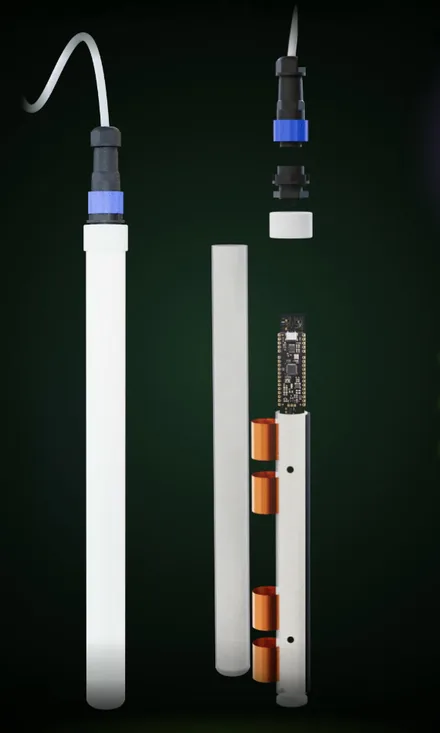
 ▶ Watch the 3D clip (Thai)
Watch on YouTube · Facebook · TikTok
HR-Soil 2CH
2 measuring depths · 30 cm
฿3,290
Upper and lower root zone. The specs and manual on this page are for this model.
See 2CH specsKnow where the water is in the root zone — moisture, temperature and an EC indicator at 2, 4 or 8 depths in one probe (30 / 60 / 100 cm long), sent over RS485 Modbus RTU into the system you already have, or to the HR-Soil Gateway on your phone.
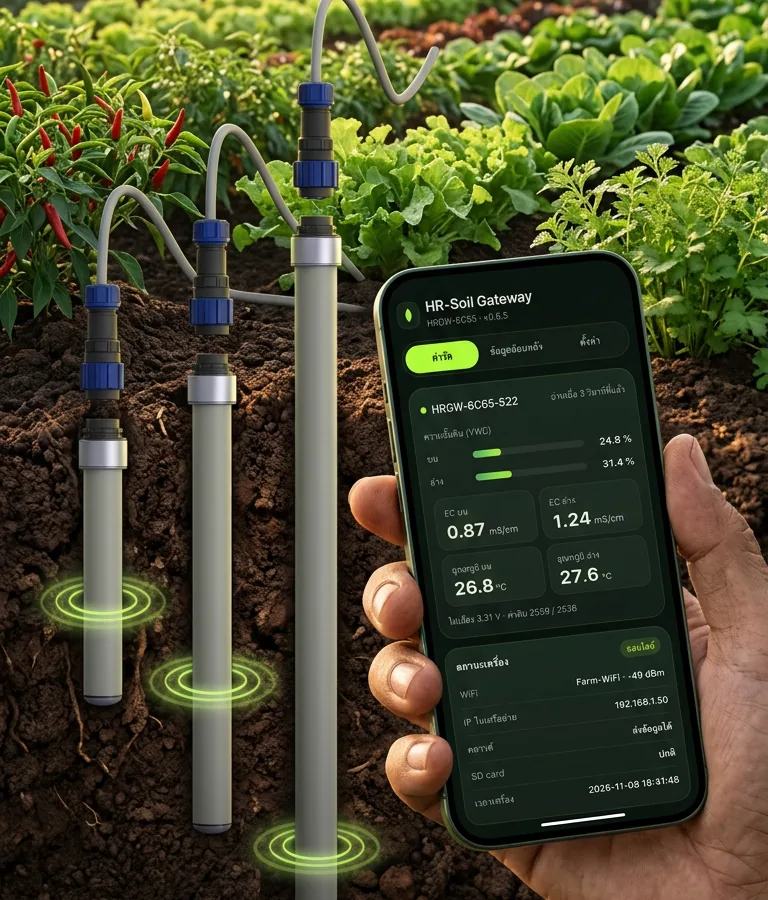
A single-point moisture sensor only tells you how wet the soil is right there. The question an irrigator actually asks is did the water reach the roots — and did it drain past them?
Water hasn't reached the lower roots yet: the irrigation was too short or the soil is compacted.
Water is spread through the root zone; no need to irrigate again yet.
Water and fertilizer are draining past the roots — both are being wasted.
More measuring points show how water moves down through the soil, not just whether it is wet or dry.
Answers the core irrigation question: did water reach the roots, and did it go past them? Suits shallow-rooted crops such as vegetables and greenhouse crops.
Shows water soaking down step by step, so you see how deep each irrigation reaches and how long it takes. Suits fruit crops, medium-deep roots or layered soils.
A moisture profile along the whole depth, including which layer the roots draw water from (moisture dropping in steps during the day). Suits tree crops, trial plots and fine-grained irrigation planning.
HR-Soil comes in three models and all of them can be ordered. The channel count is the number of depths measured along one probe: more channels give a finer picture of how water moves down the soil profile. Choose by the job and the crop. All models run the same firmware and connect the same way (RS485 Modbus RTU).


 ▶ Watch the 3D clip (Thai)
Watch on YouTube · Facebook · TikTok
2 measuring depths · 30 cm
฿3,290
Upper and lower root zone. The specs and manual on this page are for this model.
See 2CH specs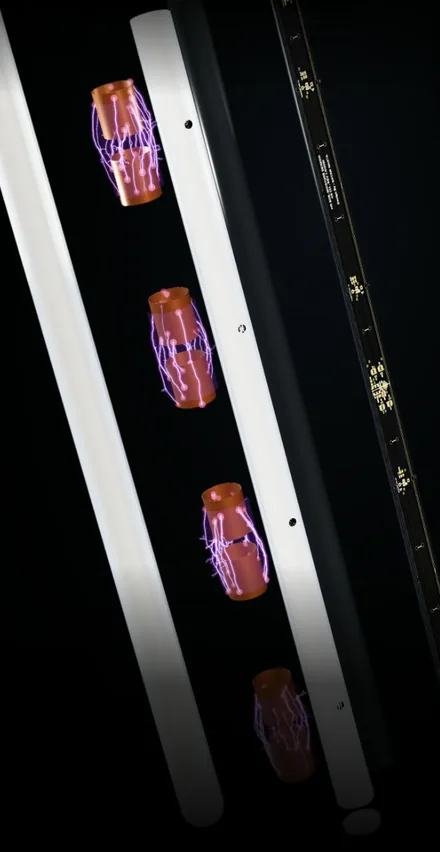 ▶ Watch the 3D clip (Thai)
Watch on YouTube · Facebook · TikTok
4 measuring depths · 60 cm
฿5,490
A longer probe that reaches deeper. The 4CH manual comes with your order.
Order / request a quote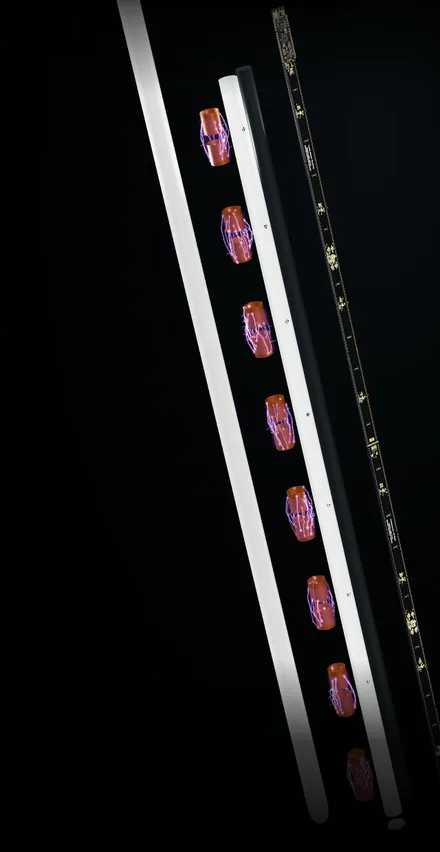 ▶ Watch the 3D clip (Thai)
Watch on YouTube · Facebook · TikTok
8 measuring depths · 100 cm
฿8,900
The most detailed moisture profile with depth. The 8CH manual comes with your order. · For durian orchards
Order / request a quoteLengths are the approximate probe body length · measuring rings are 12 cm apart (centre to centre) · probe, connectors and Gateway box are IP67 waterproof

The HR-Soil 8-depth probe shows water at every layer down to 1 m: whether it reaches the roots, whether the soil is dry enough for the flowering water stop, and whether water pools around the trunk. Kit with Gateway ฿11,900.
See the durian orchard kit AI-generated illustrationPrices in Thai baht as of 10 November 2026 · every probe comes with a 5 m cable
| HR-Soil 2CH2 depths · 30 cm | ฿3,290 |
|---|---|
| HR-Soil 4CH4 depths · 60 cm | ฿5,490 |
| HR-Soil 8CH8 depths · 100 cm | ฿8,900 |
| HR-Soil Gateway1 probe direct · built-in solar | ฿3,490 |
| Splitter box, 4 outputs2–4 probes on one Gateway · built-in solar | ฿3,990 |
| Splitter box, 8 outputs5–8 probes on one Gateway · built-in solar | ฿5,990 |
The Gateway has one RS485 port: more than 1 probe needs a splitter box, up to 8 probes per Gateway · cable longer than 5 m: ฿25 per extra metre
| Starter kitHR-Soil 2CH + Gateway | ฿6,390save ฿390 |
|---|---|
| Standard kitHR-Soil 4CH + Gateway | ฿8,490save ฿490 |
| Pro kitHR-Soil 8CH + Gateway | ฿11,900save ฿490 |
Extra probes for an existing Gateway are charged at the probe prices listed
Charts and history on the Priktai cloud. From year 2 it is charged per probe per year, billed once a year per farm.
2CH ฿694CH ฿1198CH ฿199 per year
Shipping, warranty and tax details: +66 83 567 0029 · [email protected]
Also on Shopee (prices include the platform fee, so they are higher than on this site): HR-Soil 2CH · 4CH · 8CH · store. Order direct at website prices: +66 83 567 0029
A clip of about 1.5 minutes covering every probe, the Gateway, the splitter boxes and the kits. The posters are A4 PDFs to print or pass on: prices and kits, the 2 · 4 · 8 depth specs, and how the FDR probe reads 12 soil types.
Short clips, under a minute: how one probe reads several soil layers, and why it matters whether water reached the roots.
Watch all product clips in the playlist
More explainer clips on soil, water and weather: knowledge base
Put the probe in the root zone and cable it to the HR-Soil Gateway on a solar pole. No mains power needed, logging every minute.
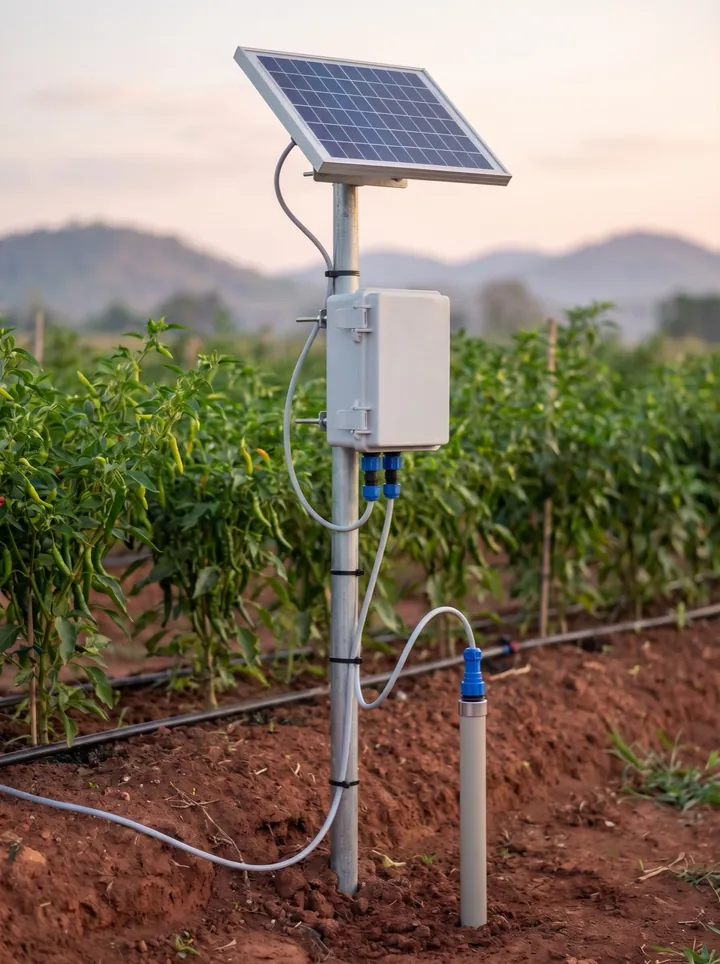
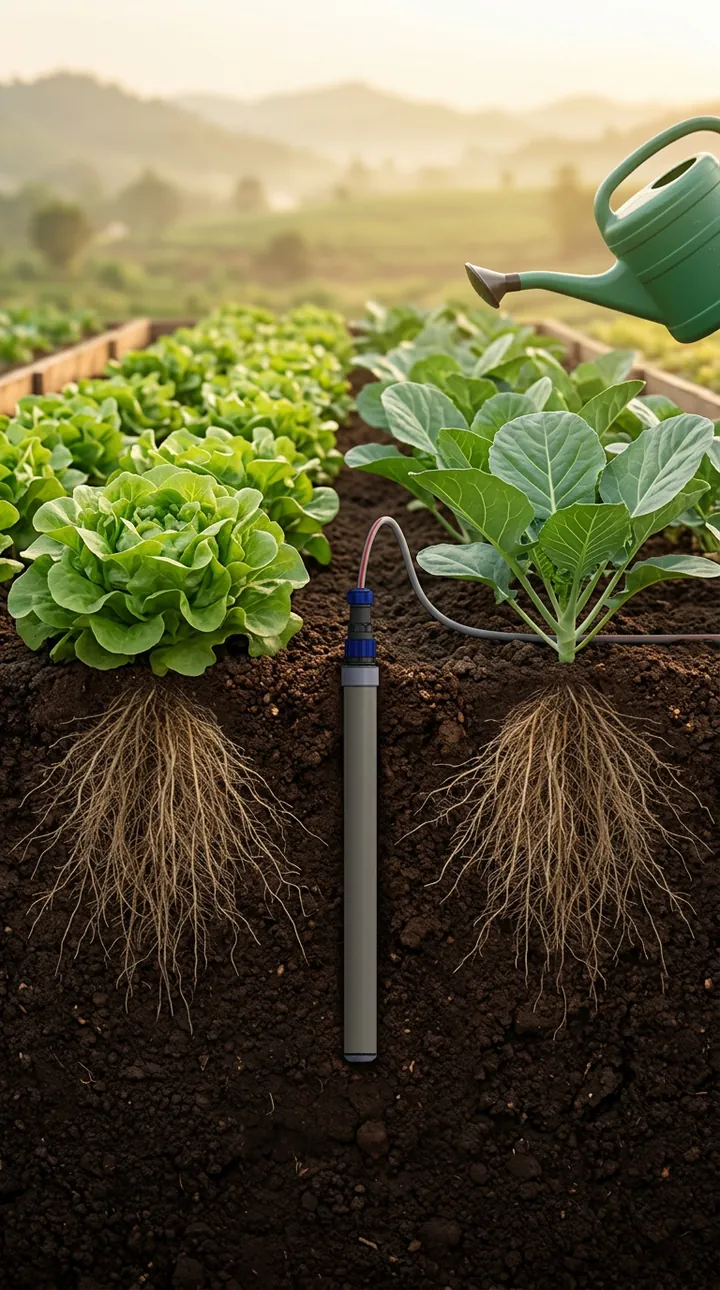
Connect the probe to the HR-Soil Gateway and open its page on your phone to see every layer. If the internet drops, it keeps logging to the SD card and you can download CSV files.
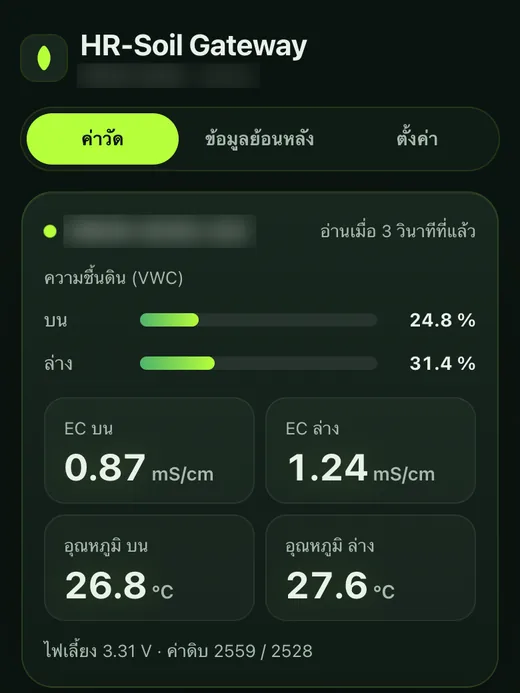
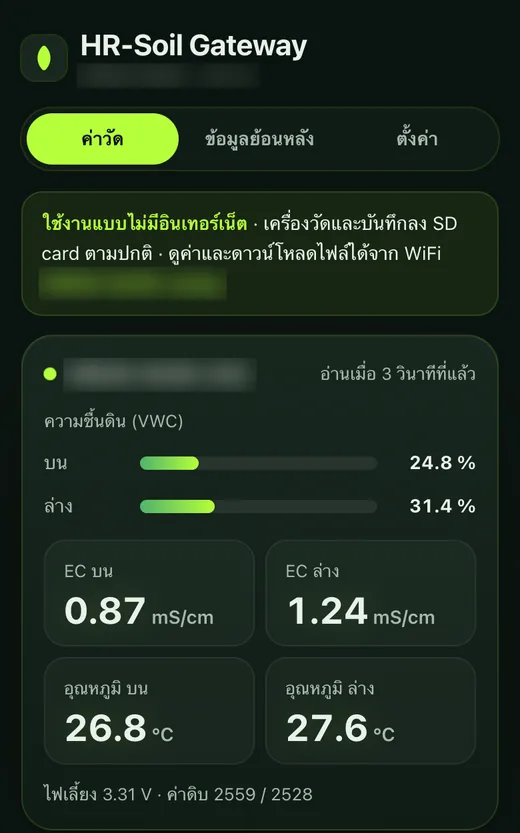
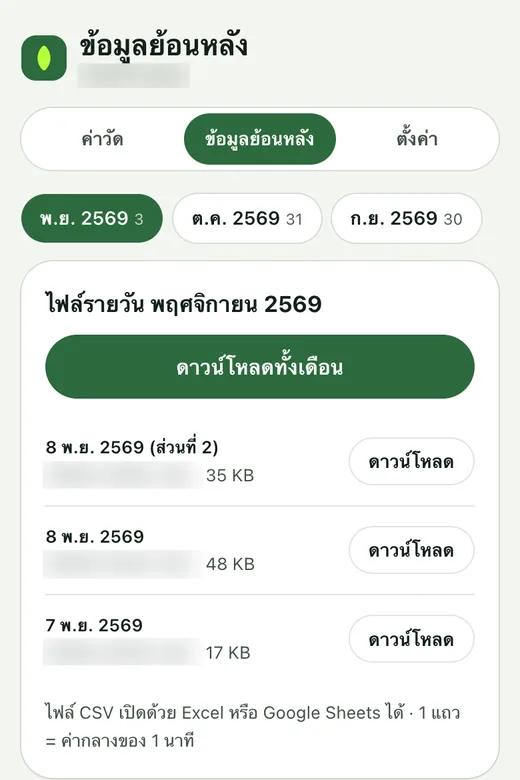
Simulated screens with sample values, Thai interface (device IDs blurred).
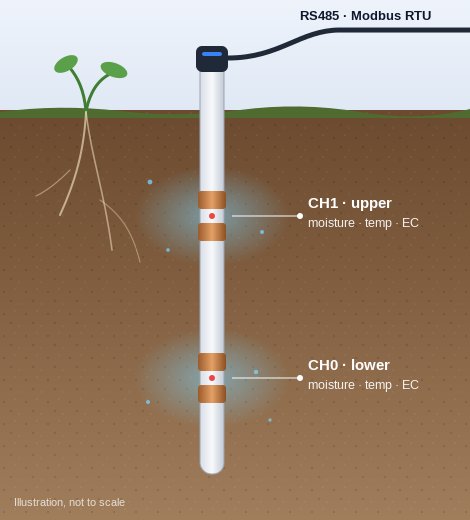
The probe has two ring pairs (CH1 upper, CH0 lower), each with its own temperature sensor. It takes a new reading about every 5 seconds and reports an average over about 30 seconds.
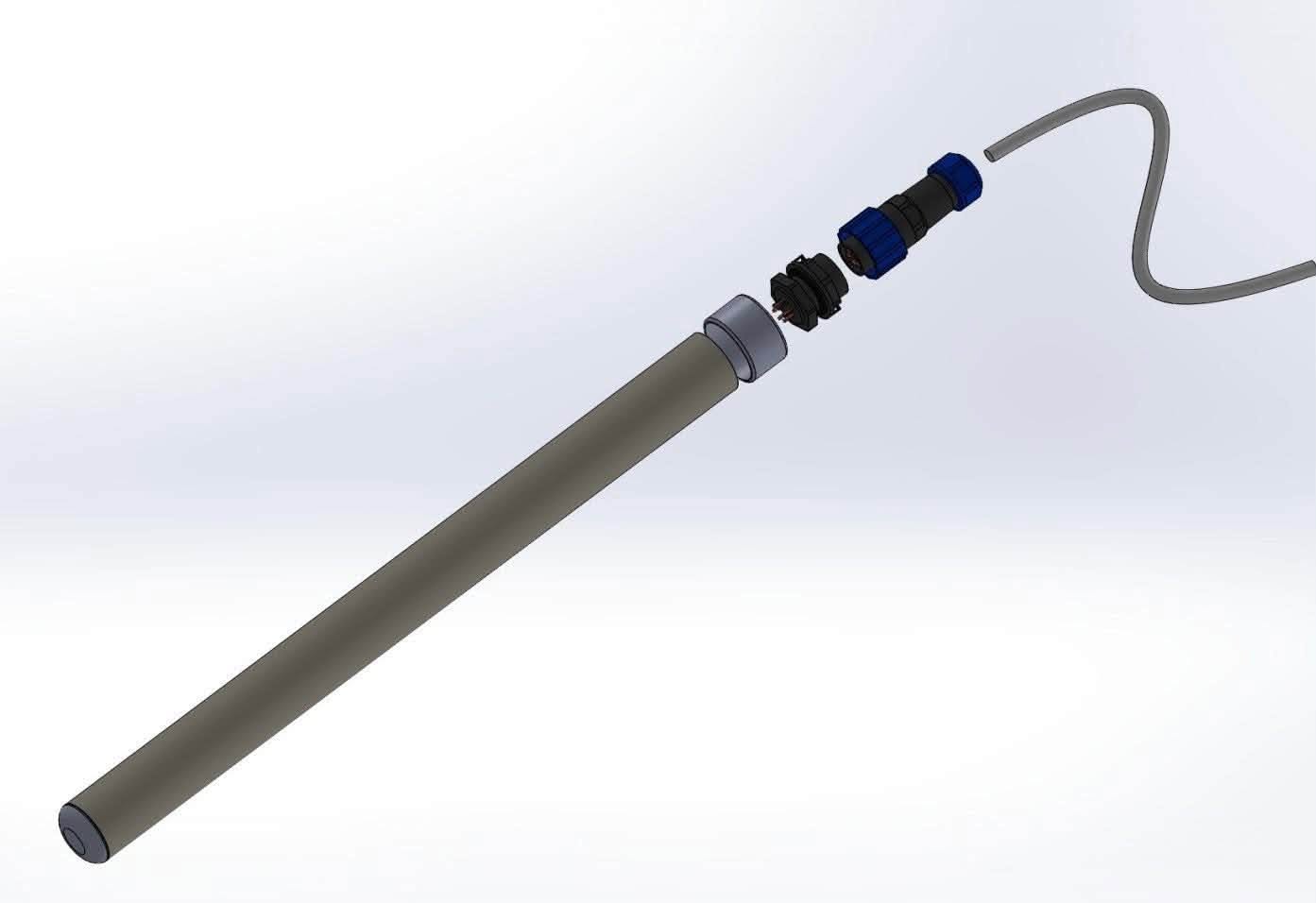
The top of the probe has a round screw-lock connector, so the cable can be removed when you move or service the probe.
Standard Modbus RTU, FC03/04/06/16, with a configurable slave ID and baud rate. The manual includes example code for Python (pymodbus) and Arduino/ESP32 (ModbusMaster).
Data lands on the same platform as our weather station and fertilizer mixing, so you can compare both soil layers with rain and sunshine on one screen. (The HR-Soil Gateway is optional; the probe itself has no WiFi. The gateway logs to an SD card every minute and shows readings on your phone even where the field has no internet.)
The CH0 ring pair sits deeper than CH1. Make sure the soil is in full contact with the probe, with no air gaps. The manual covers installation step by step.
Three RS485 wires (A, B, GND) and DC 3.3–5.5 V power. Use shielded twisted pair, and add a 120 Ω termination resistor on runs longer than about 50 m.
Record a dry and a wet point with Modbus commands. The values are stored in the probe, so the moisture reading matches that field's soil.
| Measuring points | 2 depths (CH1 upper, CH0 lower), 12 cm apart centre to centre, separate temperature sensor at each |
|---|---|
| Principle | Capacitive, with ring electrodes |
| Reported values | Moisture VWC % (0.1 % resolution) plus temperature-compensated value · temperature °C (0.01 °C) · EC indicator mS/cm · error word |
| Update rate | New reading about every 5 s; reported value averaged over about 30 s |
| Interface | RS485 half-duplex · Modbus RTU · FC03 / FC04 / FC06 / FC16 |
| Defaults | Slave ID 32 · 9600 bps · 8N1 |
| Configurable | Slave ID 1–247 · baud 4800 – 115200 |
| Power | DC 3.3 – 5.5 V (do not exceed 5.5 V) |
| Cable | Shielded twisted pair · 120 Ω termination on runs longer than about 50 m |
| Clock | Set over Modbus (no backup battery — set again after a power loss) |
| Construction | Fully resin-potted electronics, IP67 waterproof (probe and connector), vertical installation, detachable cable connector |
| Included software | Thai-language manual · example code for Python and Arduino/ESP32 |
| Manufacturer | QUANTA SYNERGY CO., LTD. · Chiang Mai, Thailand |
Customer manual for firmware 2.5.4 (in Thai): wiring, register map, clock, calibration, example code and troubleshooting.
We want you to decide on real data. The probe has passed lab and sand-box testing so far, and will be field-tested with pilot farms before delivery. These points apply to every model (2CH, 4CH and 8CH); the measured specs on this page are for the 2CH.
Yes. The probe is standard Modbus RTU over RS485 (FC03/04/06/16), defaulting to slave ID 32 at 9600 8N1. The manual (Thai) includes the register map and example code.
You should — every field's soil is different. The manual has you record two points (dry and wet soil) with Modbus commands; the values stay in the probe when the power is off.
Not yet. Use it to see whether salinity or fertilizer in the soil is going up or down. For an accurate EC of your nutrient solution, measure it with an EC meter at the mixing tank.
Not in the probe itself. To see data over the internet, use the HR-Soil Gateway, which logs to an SD card, sends to Priktai Cloud and shows readings on your phone — or read the probe yourself with an ESP32 or Raspberry Pi.
Pre-orders open in December 2026. Probes are ฿3,290 (2CH), ฿5,490 (4CH) and ฿8,900 (8CH), each with a 5 m cable. Kits with the HR-Soil Gateway start at ฿6,390. See the price table.
The cloud is free for the first year. From year 2 it is ฿69 (2CH), ฿119 (4CH) or ฿199 (8CH) per probe per year. Without renewal the Gateway still logs to its SD card and you can view readings on your phone for free.
Part of the Priktai platform — use the pieces together, from measuring soil and weather to delivering water and fertilizer.
See how they work togetherTell us what you grow, what growing medium you use and which system you want to connect to, and we'll come back with a quote. Farms interested in joining the field trial are welcome to get in touch too.