
Sprinklers on.
Did the water reach the roots?
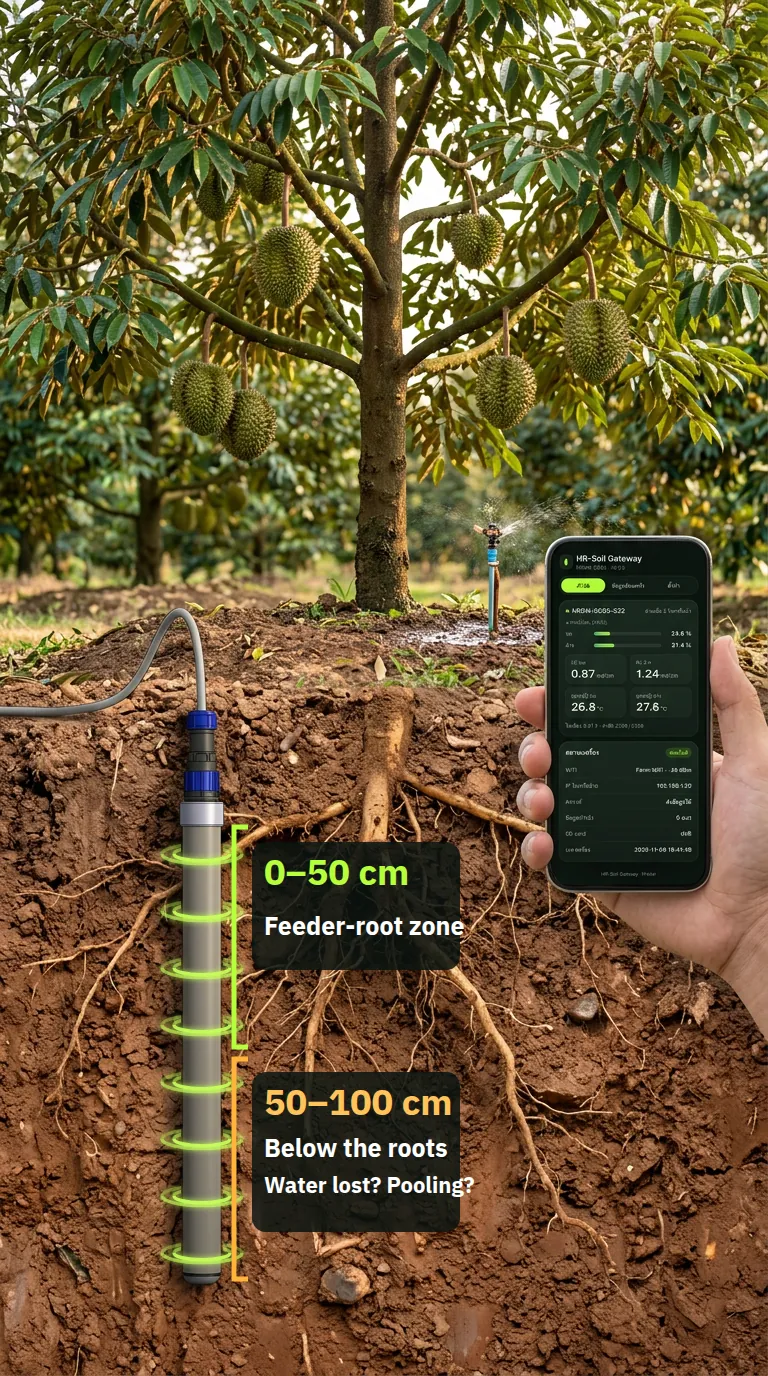
The HR-Soil 8-depth probe goes 1 metre into the ground and shows moisture at every layer, from the surface to below the root zone. See whether water reached the feeder roots or drained past them, whether the soil is dry enough during the flowering water stop, and whether water is pooling around the trunk. No need to wait for wilting leaves to know the tree is thirsty.
In a durian orchard, water at the wrong time hurts both ways
A durian tree takes years to bear fruit. Growers today go by rainfall, counted days and the leaves, but cannot see what the water is doing at each soil layer.
Waterlogging, poor drainage
Conditions that favour root and collar rot caused by Phytophthora, which Thailand's Department of Agriculture lists as a major durian disease. Signs: pale, dull, drooping leaves at the branch tips, a declining tree, and sometimes a dead tree.1
Drought stress
In the 2023–24 drought some growers in Chumphon lost standing trees, and growers in Chanthaburi had to buy water.5
Dry spells while the flesh develops
Raise the risk of "tao phao", dry brown flesh at the tip of the pod.6
Too much water before harvest
Heavy rain or excess soil moisture as fruit matures raises the risk of wet core.4 Some sources disagree that water is the main cause.
Why 8 depths
Most durian feeder roots sit near the surface under the canopy,1 roughly in the top 50 cm.2 The 100 cm HR-Soil 8-depth probe sees both the root zone and the soil below it in one probe.
Every depth reports moisture, soil temperature and EC (an indicator for salt or fertilizer trends).
| Zone | Depth | What to look for |
|---|---|---|
| Feeder root zone | 0–50 cm | Enough water? Drying out? When to irrigate |
| Below the roots | 50–100 cm | Water draining past the roots, or pooling below |
Read the soil, know whether to irrigate
Look at the moisture of all 8 depths on your phone, then adjust irrigation and drainage. This table is our guide, summarised from the Department of Agriculture documents and research listed below.
| What you see | What it means | What to do |
|---|---|---|
| 30–60 cm stays saturated for days after rain | Poor drainage; soil like this favours root and collar rot | Check ditches and drainage, stop adding water |
| 70–100 cm gets wet every time the sprinklers run | Water is draining past the roots | Shorten or space out irrigation |
| 0–50 cm stays dry through a dry spell | Feeder roots are short of water | Irrigate before the tree is stressed |
| Root zone drying while the flesh develops | Risk of "tao phao" | Keep watering steady, don't let it dry out |
| Moisture jumps after rain just before harvest | Risk of wet core | Drain, mulch, cut water as advised before harvest |
| EC rising at several depths together | Salt or fertilizer building up, e.g. saltwater intrusion | Have water and soil tested by a standard method |
Department of Agriculture advice ("Durian production")1
- During leaf flushing after harvest, irrigate when there has been no rain for over 7 days
- Stop watering for at least 10 consecutive days to induce flowering
- One week before the flowers open, give one third of the usual water
- Give 70% of the usual water when fruit is 4 weeks old and 85% at 10–11 weeks
- In high-rainfall areas plant on raised mounds to help drainage
During the water stop, HR-Soil shows whether the root-zone soil has really dried, instead of going by the day count alone.
An example from Monthong research in Chanthaburi: trees began to show water stress when soil moisture fell below 0.19 m³/m³.3 That value depends on the soil of that plot. Use it as an example, not a universal threshold, and compare your own orchard's trend with how the trees look.
What the probe cannot do
- The probe does not detect, prevent or cure disease. It shows soil conditions that favour disease, such as long waterlogging, so you can fix irrigation and drainage.
- For disease, consult agricultural extension officers or plant pathologists as usual.
- One probe shows the soil where it sits. Place probes under the canopy of a representative tree in each zone, such as low and high ground.
- EC is an indicator for trends and cannot be compared directly with irrigation-water salinity limits.
Installing in a durian orchard
Probe under the canopy
Push the 8-depth probe in under the canopy, near the drip line or sprinkler, not right against the trunk.
Pole and Gateway
Set a 1–1.5 inch steel pole and mount the IP67 HR-Soil Gateway and its 6 W solar panel. No power cable needed.
Several points
More than one probe goes through a splitter box, up to 8 probes per Gateway, so you can cover several zones.
Check on your phone
See live readings on your phone even with no internet; data logs to a 32 GB SD card every minute.
Durian orchard kit pricing
Prices in Thai baht as of 10 November 2026 · the probe comes with a 5 m cable
| Pro kitHR-Soil 8-depth probe + Gateway | ฿11,900save ฿490 |
|---|---|
| Extra 8-depth probefor an existing Gateway (up to 8) | ฿8,900 |
| Splitter box, 4 outputs2–4 probes on one Gateway · built-in solar | ฿3,990 |
| Splitter box, 8 outputs5–8 probes on one Gateway · built-in solar | ฿5,990 |
| Cable beyond 5 m | ฿25per metre |
Cloud: first year free
From year 2 it is ฿199 per 8-depth probe per year. Without renewal the Gateway still logs to its SD card and you can view readings on your phone for free.
Other models and kits: all HR-Soil pricing · ask us about shipping, warranty and tax.
Watch the short clip, then print the posters
A clip of about 1 minute on what an 8-depth probe tells you in a durian orchard. The A4 PDF posters can be pinned up in the orchard, shared in grower groups or passed on.
Frequently asked questions
How does a soil moisture sensor help a durian orchard?
The HR-Soil 8-depth probe shows soil moisture at every layer from the surface to 1 metre, so you can see whether irrigation reaches the feeder roots or drains past them, whether the root zone is dry enough during the water stop, and whether water pools after rain. Then you adjust irrigation and drainage.
Can the probe prevent root and collar rot?
No. The probe does not detect, prevent or cure disease. It shows soil that stays waterlogged for long periods, a condition that favours Phytophthora, so you can fix drainage and irrigation. For disease, consult extension officers or plant pathologists.
During the flowering water stop, how do I know the soil is dry enough?
The Department of Agriculture advises stopping water for at least 10 consecutive days. HR-Soil shows whether the root-zone soil has really dried instead of relying on the day count alone. The right level depends on each orchard's soil, so compare your own trend with how the trees look.
How many probes do I need, and where?
One probe shows the soil where it sits. Place probes under the canopy of a representative tree in each zone, such as low and high ground, near the drip line or sprinkler. The Gateway has one RS485 port; for more than one probe add a splitter box with 4 outputs (฿3,990) or 8 outputs (฿5,990), up to 8 probes per Gateway.
Does it work in an orchard with no internet?
Yes. The HR-Soil Gateway logs to an SD card every minute and opens its own WiFi so your phone can view live readings and download data. It runs on a 6 W solar panel with no power cable.
How much is the durian orchard kit?
The pro kit, an HR-Soil 8-depth probe plus Gateway, is ฿11,900 with a 5 m cable. Extra 8-depth probes are ฿8,900 each. The cloud is free for the first year, then ฿199 per probe per year.
Sources
- Thailand Department of Agriculture, Durian production and Durian root and collar rot (Thai)
- ACIAR / Queensland DPI, Integrated management of Phytophthora diseases of durian
- Kasetsart Journal, Stem water potential, durian cv. Monthong
- HortScience 31(1):112 (1996), wet core in durian
- Thai PBS, Drought in durian orchards · Prachachat, growers buying water (Thai)
- Technology Chaoban, tao phao in durian · QYield, durian water care (Thai)
Part of the Priktai platform. Works with the weather station and fertigation system, all data in one place.
See how it fits togetherWant to see the water in your durian orchard's soil?
Tell us the province, the size of the orchard, how you irrigate and whether any low ground floods. We'll suggest how many probes to place and where.